

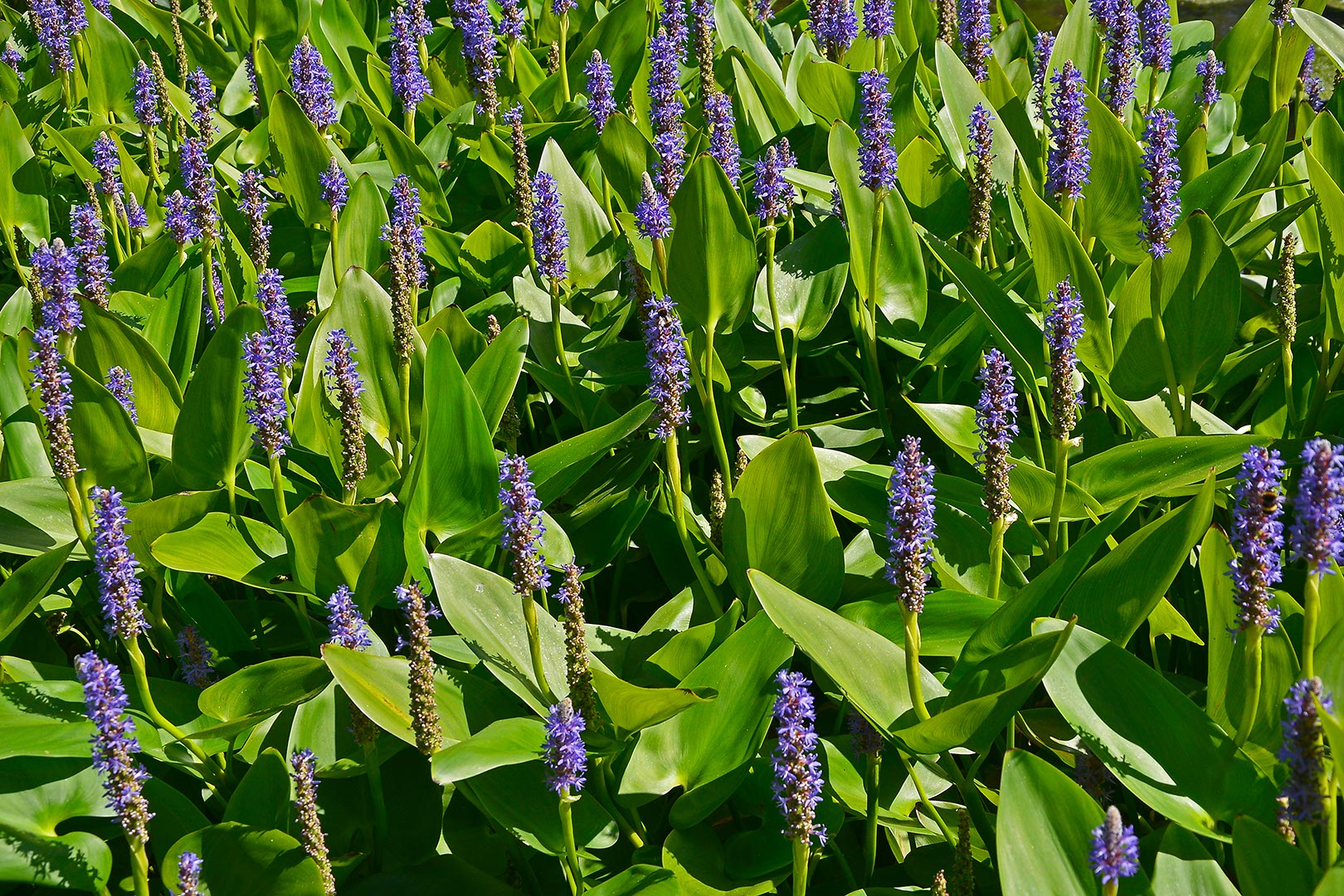
Pontederia cordata, commonly known as pickerelweed, pickerel rush, or purple pickerelweed, is a deciduous emergent marginal aquatic perennial that landscape professionals increasingly turn to for retention pond and stormwater basin plantings. With a mature height of 2 to 4 feet, this North American native provides both functional bank stabilization and consistent seasonal color. When specified for commercial projects, Pontederia cordata – pickerelweed delivers a low maintenance solution that thrives in the shallow water margins typical of retention ponds. This article covers the plant’s growth habits, ecological benefits, and wholesale availability for municipal and commercial stormwater applications.
Pontederia cordata – Pickerelweed for Retention Pond Shorelines
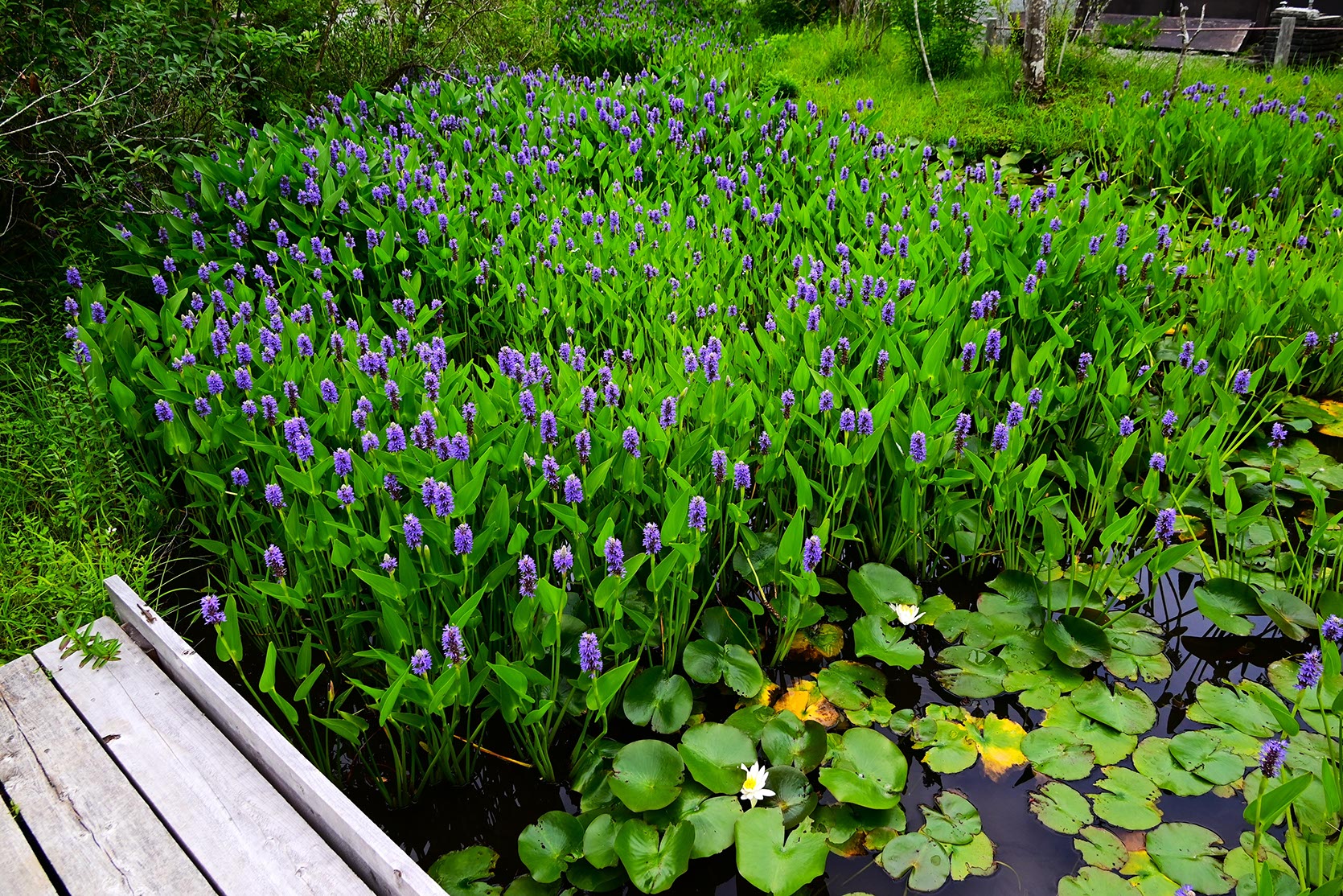
Retention pond shorelines present a challenging environment: seasonal water level fluctuations, periods of full sun, and nutrient‑rich runoff. Pontederia cordata – pickerelweed is well‑suited for these conditions because of its aggressive yet manageable growth habit. The plant spreads by rhizomes to form dense colonies that hold soil in place and reduce erosion along pond edges. According to UF/IFAS Gardening Solutions, pickerelweed grows best in a sunny location and requires shallow water no more than a foot deep. For specifiers, this means the plant can be placed in the 0‑ to 12‑inch depth zone of a retention pond, where it will establish a stable shoreline margin that tolerates fluctuating water levels.
Pickerelweed is a true pond plant that requires water depths greater than saturation, as noted by the Native Plant Society of Texas. It is not a moist‑soil accent – it needs standing water to perform at its best. Landscape architects and contractors can count on Pontederia cordata – pickerelweed as a reliable species for the wetter portions of stormwater basins, where few other herbaceous perennials establish as readily.
Violet‑Blue Spikes That Pull Pollinators to the Water’s Edge
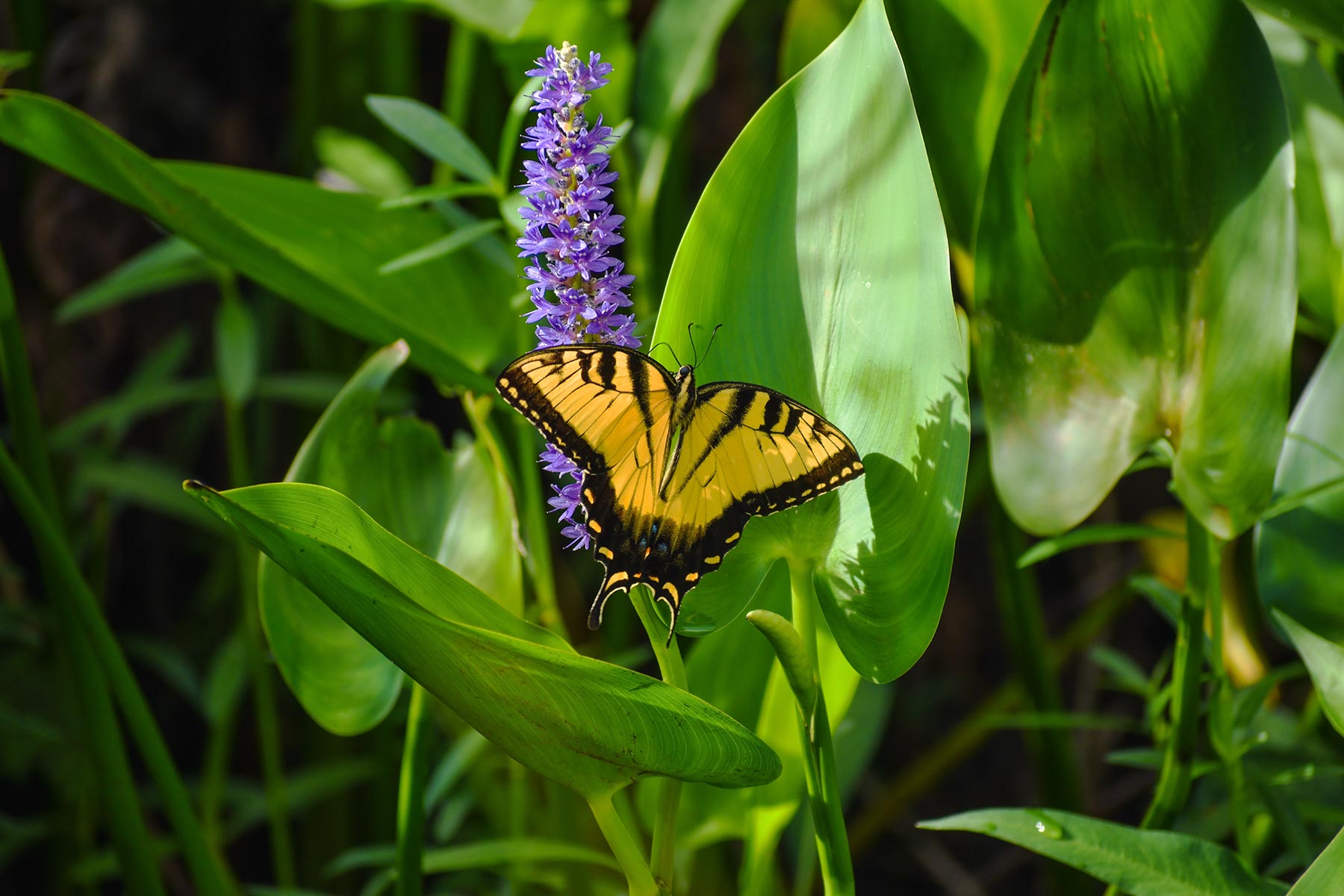
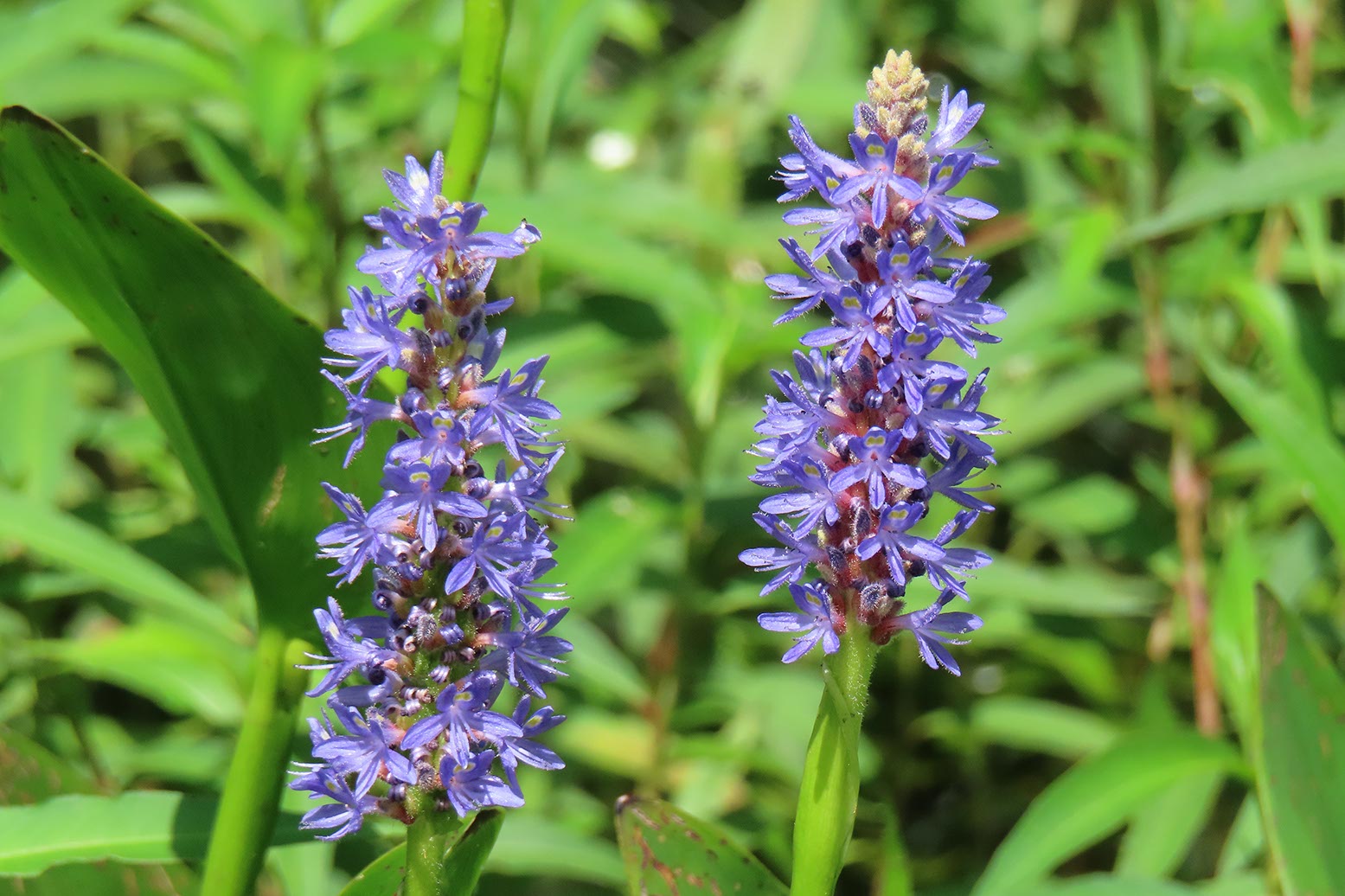
From spring through fall, Pontederia cordata – pickerelweed produces purple‑blue flower spikes that rise above the glossy heart‑shaped leaves. These spikes are not just decorative; they serve as a nectar source for butterflies and bees. The Lady Bird Johnson Wildflower Center reports that pickerelweed provides nectar for both bees and butterflies, making it an excellent addition to wetland gardens and habitat restoration projects. The seeds are eaten by birds, and ducks will consume the entire plant. For commercial projects that require pollinator support credits or habitat mitigation, Pontederia cordata – pickerelweed provides documented ecological value across multiple trophic levels.
The flower color and form are strong visual anchors for retention pond shorelines, particularly when massed. By spacing plants about 4 feet apart, as recommended by UF/IFAS Gardening Solutions, a nice stand develops that creates a solid block of violet‑blue color during the warmer months. This visual uniformity is desirable for high‑visibility stormwater ponds in commercial, municipal, and residential developments.
Water Filtration and Sediment Stabilization in 0–12 Inches of Standing Water
Beyond its ornamental appeal, Pontederia cordata – Pickerelweed provides significant ecological and water quality benefits in retention ponds, stormwater facilities, rain gardens, constructed wetlands, and naturalized water features. Its dense rhizome network helps trap suspended sediments while absorbing excess nutrients from runoff that might otherwise contribute to algae growth and declining water quality. When established along pond margins and shallow shelves, pickerelweed serves as a natural filtration zone, helping improve water clarity and overall aquatic health.
Planting depth should be considered carefully for optimal performance. Pickerelweed establishes most successfully in shallow water, generally within the 2- to 8-inch depth range, although mature plants can tolerate water depths of up to 12 inches. This makes it particularly valuable for retention pond shelves, shoreline plantings, bioswales, wetland edges, and other areas subject to periodic fluctuations in water levels. The species also adapts well to a wide range of growing conditions and performs in acidic, neutral, and moderately alkaline waters, making it suitable for many stormwater and restoration projects throughout Georgia, North Carolina, and Tennessee.
For projects where spread must be more carefully managed, pickerelweed can be installed in contained planting areas or aquatic containers. Combined with its striking violet-blue flower spikes, exceptional pollinator value, wildlife habitat benefits, and water-quality-enhancing characteristics, Pontederia cordata remains one of the most dependable and versatile native aquatic plants for commercial landscapes, ecological restoration projects, retention ponds, and stormwater management systems across the Southeast.
Hardiness Across Zones 3–10, One Plant, Multiple Regions
Pontederia cordata – pickerelweed is native to a broad swath of North America. It is frost resistant and grows from USDA hardiness zone 3 through zone 10. This wide range means that a single species specification can be applied to projects in northern states, the Midwest, the Southeast, and the Pacific Northwest without switching to a different plant. For national accounts or large‑scale developers working across multiple regions, pickerelweed provides consistency in sourcing and performance.
In Florida, pickerelweed is a native aquatic plant found throughout the state, as noted by UF/IFAS Gardening Solutions. In Texas, the Native Plant Society of Texas highlights its low‑maintenance nature and requirement for true wetland conditions. In colder zones, plants die back to the crown in winter but reemerge in spring. Because it is native, pickerelweed supports local ecosystems without the risks associated with non‑native ornamental aquatics.
Specifying Pickerelweed for Municipal and Commercial Stormwater Projects
When writing specifications for retention pond plantings, Pontederia cordata – pickerelweed fits several common design goals. It stabilizes shorelines against wave action and storm events. It provides pollinator habitat that can help projects meet LEED or Sustainable Sites Initiative credits. It removes nutrients through phyto‑purification. And it requires no fertilization or supplemental watering once established.
For best results, specify at least a 2‑inch depth of standing water at the planting zone, with full sun exposure. Use a spacing of 4 feet on center to achieve a solid stand within two growing seasons. If the soil is compacted or clay‑heavy, this is not a concern, pickerelweed is adapted to the saturated, nutrient‑rich conditions found in retention pond bottoms. Plan for planting in late spring or early summer when water temperatures are warm and growth will be rapid. To control excessive spread in formal basins, plant within submerged planting baskets.
Wholesale Availability, Ready‑to‑Ship Pontederia cordata for Your Next Project
Baker Environmental Nursery supplies Pontederia cordata – pickerelweed to landscape contractors, nurseries, municipalities, and green‑industry professionals across the United States. As a wholesale‑only grower, we offer this species in quantities suitable for large‑scale stormwater and restoration projects. Our plants are grown in accordance with best practices for native wetland perennials, ensuring strong root systems and consistent quality.
We invite you to check our live inventory for current availability of pickerelweed. For project‑specific quantities, contract growing needs, or custom specifications, contact our team for a quote. Baker Environmental Nursery delivers confidence that starts at the root, and Pontederia cordata – pickerelweed is a proven performer for retention pond shorelines nationwide.
CLICK HERE FOR CURRENT AVAILBILITY
Frequently Asked Questions
What is the ideal planting depth for Pontederia cordata in a retention pond?
Planting depth is an important consideration for successful establishment. Pickerelweed performs best in shallow water, typically with 2 to 8 inches of standing water over the crown. This depth range encourages vigorous rooting and rapid establishment while allowing the plant to maximize its water quality and habitat benefits. Once established, pickerelweed can tolerate water depths approaching 12 inches, making it well suited for retention ponds, stormwater facilities, wetland shelves, shoreline plantings, and other areas with fluctuating water levels.
How far apart should pickerelweed be spaced to form a solid stand?
UF/IFAS Gardening Solutions recommends spacing plants about 4 feet apart. At this distance, pickerelweed will fill in within one to two growing seasons to create a dense colony that stabilizes shorelines and provides uniform flower color. Closer spacing may speed coverage but requires more plant material.
Does pickerelweed attract pollinators and wildlife?
Yes. The violet‑blue flower spikes provide nectar for butterflies and bees. Seeds are eaten by birds, and ducks consume the entire plant. The Lady Bird Johnson Wildflower Center lists pickerelweed as good for wetland gardens and habitat, making it valuable for projects requiring pollinator or wildlife credits.
Can pickerelweed be grown in containers to control spread?
Yes. To limit spread in a retention pond, plant pickerelweed in containers without drainage holes. This method prevents rhizomes from escaping into the pond substrate. UF/IFAS Gardening Solutions recommends this technique for managed basins where aggressive growth is not desired.
What zones is Pontederia cordata hardy in?
Pickerelweed is frost resistant and hardy across USDA zones 3 through 10. It is native to North America and found throughout Florida and much of the eastern and central United States. The same plant can be specified for projects in northern, midwestern, and southern regions.