

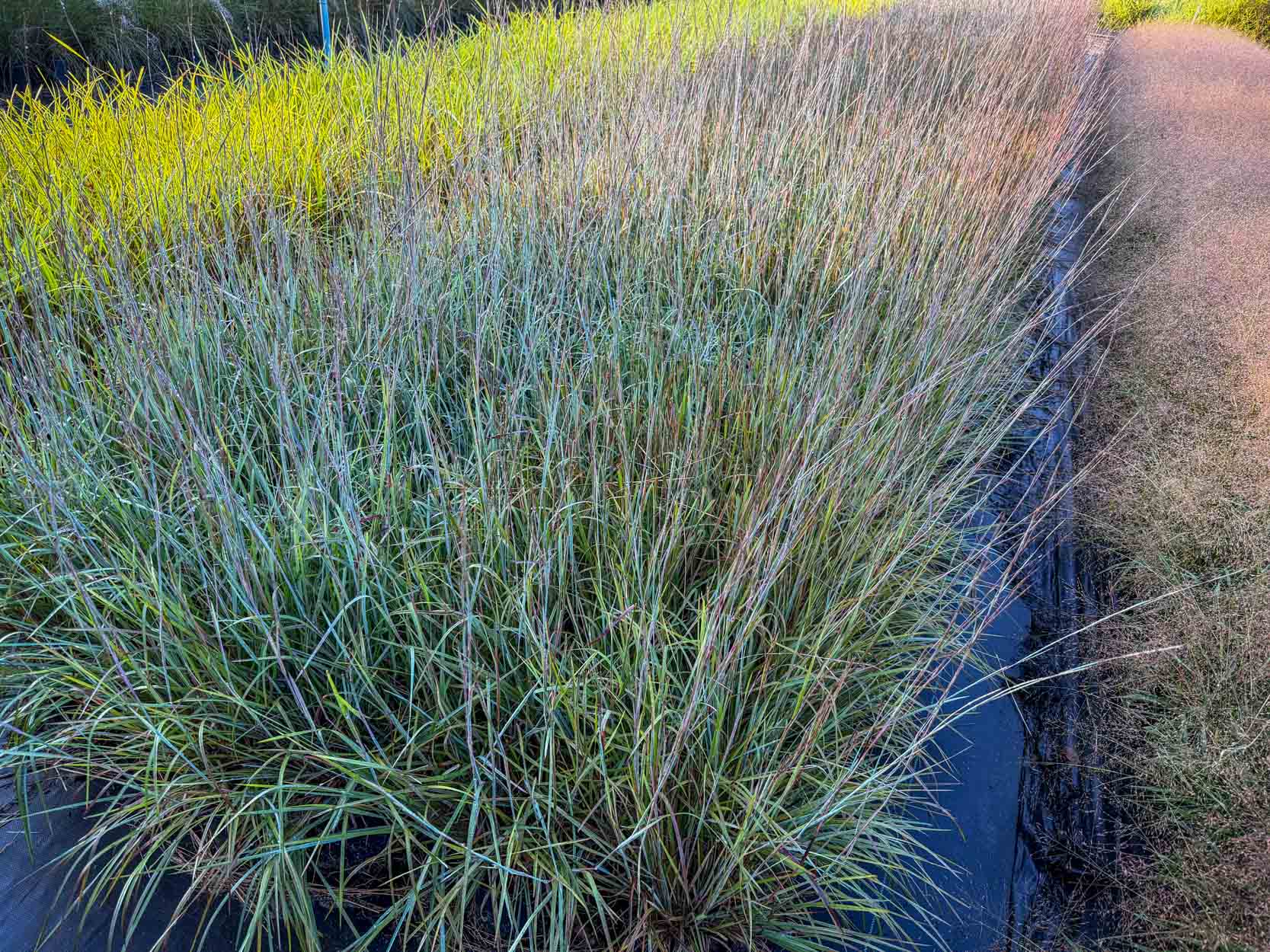
Little bluestem has spent decades on the edge of mainstream planting design, admired by prairie restoration crews and largely ignored by everyone else. That has changed. Schizachyrium scoparium now shows up in municipal streetscapes, parking lot islands, green infrastructure plantings, and high-visibility commercial beds where designers want structure without irrigation. ‘The Blues’ is the selection buyers ask for by name because its foliage carries a stronger blue tone than the straight species, and because it fits the way large projects are actually planted: in quantity, in mass, and with minimal aftercare.
Baker Environmental Nursery grows and supplies native grasses, sedges, perennials, and wetland plants at wholesale volume, and little bluestem is one of the workhorses of that catalog. This page covers what the references say about the plant, how it behaves in a commercial setting, and how a wholesale or contract grow order comes together for a project of real size.
Why Little Bluestem Earns Its Place in Commercial Plantings
Schizachyrium scoparium is a perennial, ornamental, warm-season grass in the Poaceae family with attractive foliage, and it is native to eastern North America. It is also widely described as one of the most beloved native grasses in North America, which is a rare thing for a plant that also happens to be tough. Reference material on the species describes a resilient grass that thrives in challenging conditions, withstands drought, and tolerates salty areas.
For a landscape contractor, that combination does real work. A plant that holds up in dry, sunny, exposed locations reduces callbacks, protects the installation budget, and keeps a specification defensible long after the punch list is closed. The key traits the references support include:
-
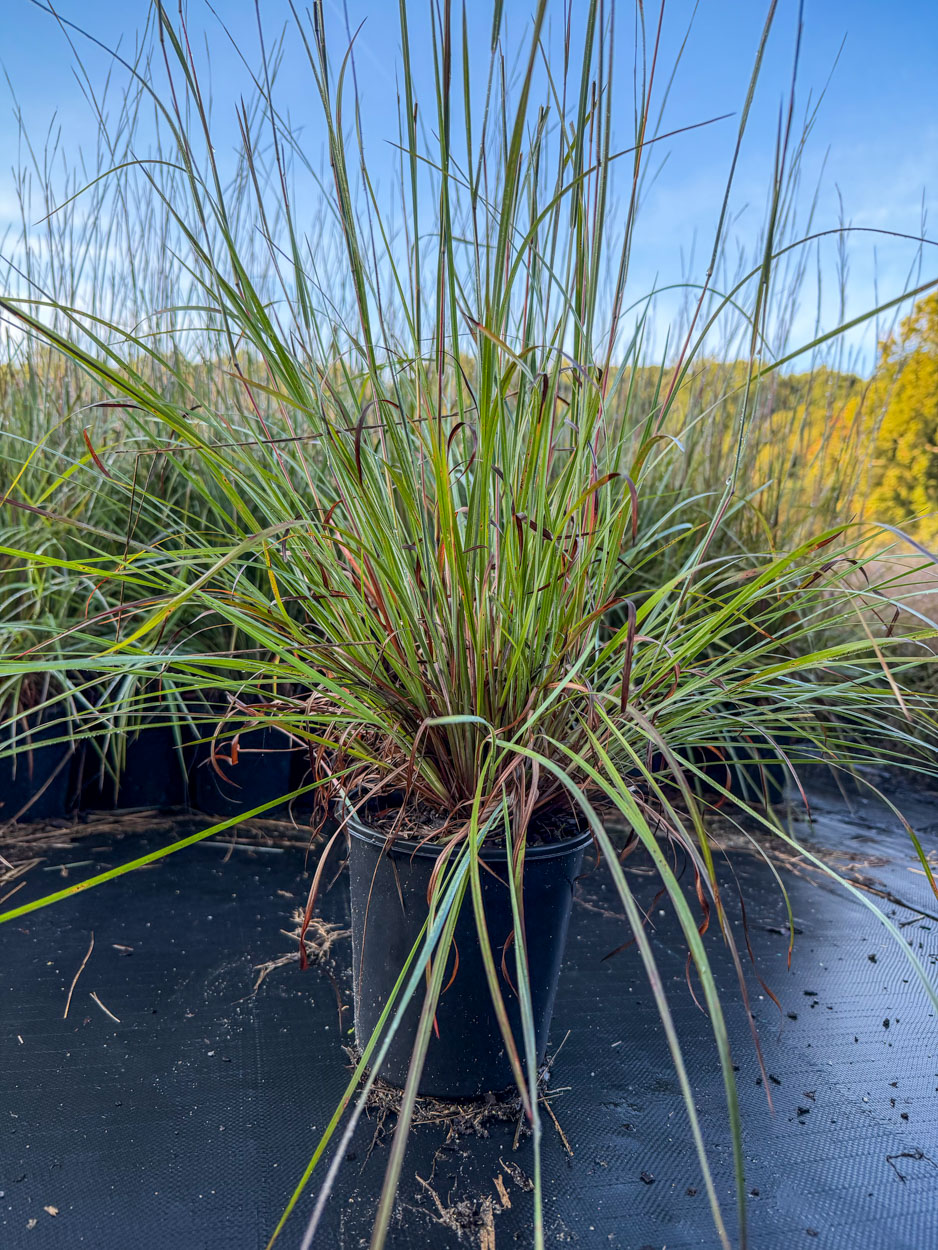
Fine-textured foliage that forms very dense mounds, described at roughly 18 to 24 inches tall.
-
Slender blue-green stems that often reach above the foliage mass.
-
An upright, bunchgrass form rather than a spreading, floppy habit.
-
Excellent season-long color, with blue-green stems providing summer contrast.
-
Strong performance in dry, sunny areas where irrigation is limited or absent.
-
Tolerance of drought and of salty conditions.
-
Seed production that feeds birds.
-
Low-maintenance care once established, which suits large installations with limited maintenance budgets.
Little bluestem is also a native, warm-season prairie grass, and it has been growing in popularity specifically because of its ornamental value. That matters for projects where the planting plan needs to satisfy both an aesthetic review and an ecological or native-plant requirement at the same time.
What Sets ‘The Blues’ Apart in the Schizachyrium Lineup
Foliage color is the reason this cultivar exists in the trade. Reference descriptions of western selections of little bluestem note gray-blue foliage paired with a strong, upright habit, and that same plant profile also provides seeds for birds. ‘The Blues’ is grown for buyers who want that cooler, blue-leaning tone rather than the greener cast of ordinary little bluestem.
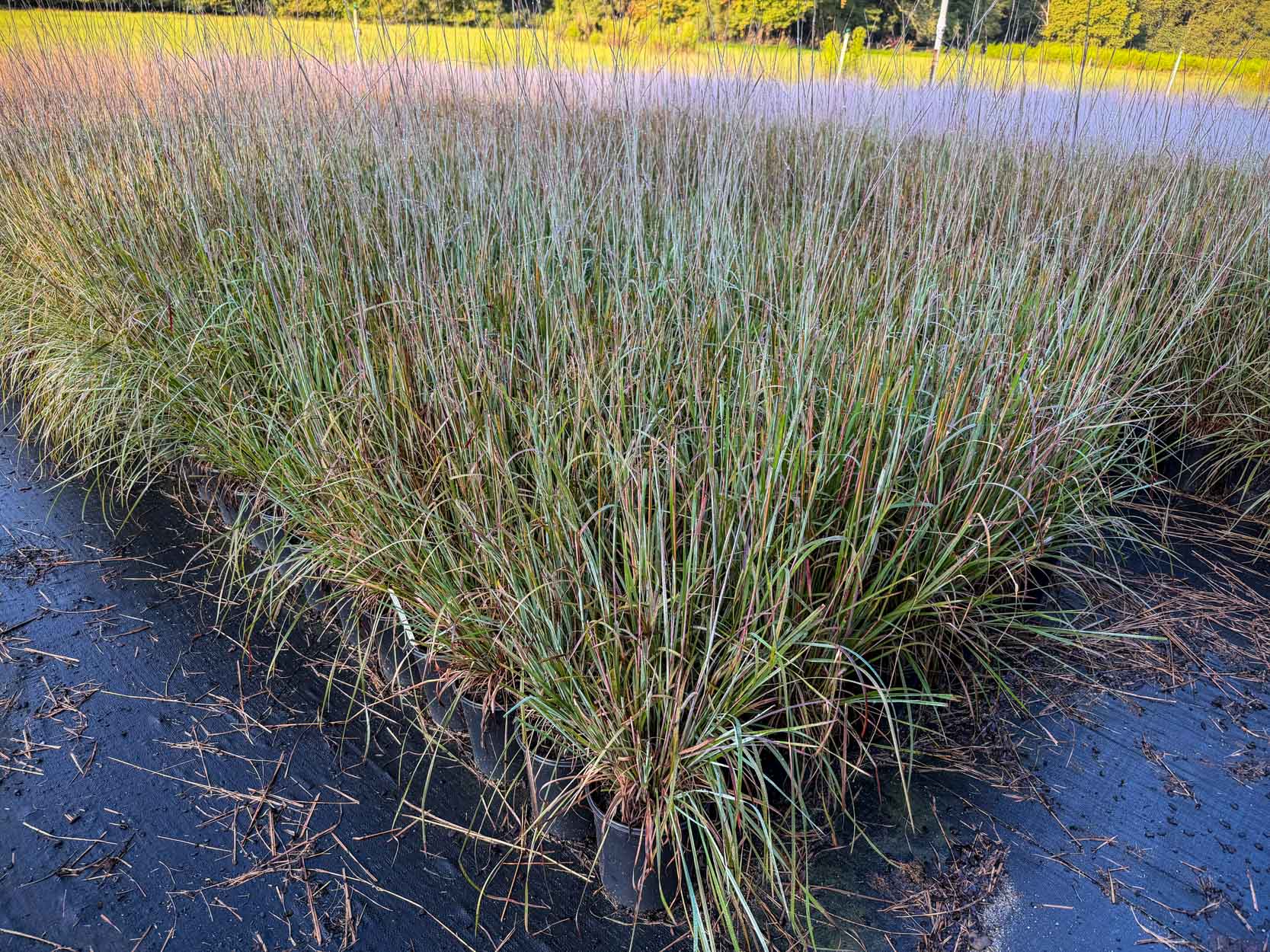
In a commercial planting, the color shift changes how a bed reads. Blue-toned foliage separates cleanly from warm green groundcovers and from the deeper greens of shrubs, and it holds that contrast through the summer months when many perennials have finished their first flush. Because the stems are slender and upright, the color registers as a mass rather than as individual clumps, which is exactly the effect designers want when planting a slope, a median, or a long foundation bed.
For specification writers, the practical guidance is this: name the cultivar on the plan and confirm the grower is supplying that cultivar rather than a generic species plug. Color selection is a real variable in this genus, and substitutions are visible in the finished landscape.
Site Conditions and Cultural Basics
Light and exposure
Little bluestem is described in plug and production listings as thriving in full sun, and it is recommended as a decorative grass for dry, sunny areas. That is not a soft preference. The species is at its best in open, unshaded conditions where airflow is good and the foliage dries quickly. Shade tends to produce lax growth and weaker stem color, which undercuts the reason to specify ‘The Blues’ in the first place.
Soil and moisture
Drought tolerance is one of the species’ headline traits, and it performs in challenging conditions where other ornamentals struggle. It tolerates salty areas as well, which opens up placements near roadways and in coastal-influenced projects where salt exposure is part of the site’s reality. The cultural profile that emerges from the references is straightforward: a warm-season bunchgrass that wants sun, handles dry stretches, and does not demand coddling once it is established.
Planting timing
The reference material reviewed for this article does not settle on a single best planting window or definitively answer every establishment question, including how aggressively the species spreads on a given site. Rather than guess, treat timing as a project-specific decision. Confirm the window with your local extension guidance, with the project specification, and with your grower before you schedule a delivery. What the references do support is that little bluestem is a warm-season grass, so its most active growth arrives with warm weather rather than in the cool shoulder seasons.
Schizachyrium scoparium ‘The Blues’ at a Glance
|
Attribute |
What the references describe |
|---|---|
|
Plant type |
Perennial, ornamental, warm-season bunchgrass in the Poaceae family |
|
Native range |
Native to eastern North America; a North American native prairie grass |
|
Form |
Upright bunchgrass with fine-textured foliage in very dense mounds |
|
Height |
Mounds described at roughly 18 to 24 inches; plug offerings listed at 1 to 3 feet |
|
Stems |
Slender blue-green stems, often rising above the foliage |
|
Foliage color |
Blue-green through summer; western selections noted for gray-blue foliage |
|
Exposure |
Full sun |
|
Moisture and stress |
Drought tolerant; tolerant of salty areas; suited to dry, sunny sites |
|
Seasonal interest |
Season-long color and year-round interest; low-maintenance care |
|
Wildlife value |
Provides seeds for birds |
Using ‘The Blues’ in Large-Scale Landscape Design
Designers reach for little bluestem when they need texture, movement, and color that survives a low-input maintenance regime. The species is a natural fit for mass plantings, where hundreds of the same plant create a continuous plane of fine foliage rather than a collection of individual specimens. That massing approach is also the most efficient way to install it, which keeps labor hours predictable on a commercial schedule.
Common placement patterns that the plant’s traits support include:
-
Broad sweeps along slopes, medians, and setback areas where irrigation is limited.
-
Parking lot islands, curb lines, and roadway edges where salt exposure and dry conditions are both present.
-
Green infrastructure and stormwater planting beds, where native grasses are frequently specified alongside perennials and wetland species.
-
Color contrast bands in front of shrubs, where blue-green summer foliage separates layers of the planting.
-
Mixed native perennial beds, paired with species such as Swamp Milkweed, New England Aster, Purple Coneflower, or Joe-Pye Weed from a native perennial program.
-
Low-maintenance commercial entries and monument areas where the plant must look intentional without weekly attention.
Because little bluestem provides seeds for birds, it also earns its place in projects where habitat value is part of the approval conversation, not just a bonus.
What Baker Environmental Nursery Does for Wholesale Buyers
Baker Environmental Nursery is a wholesale-only grower and supplier. We do not sell to retail customers. Our customers are landscape contractors and installers, nursery suppliers and re-wholesalers, municipalities and local government agencies, landscape architects and specification writers, project managers and engineers working on green infrastructure and restoration, and commercial property managers running large sites.
The catalog is built around native material at production scale: roughly 40 native grasses and sedges, 14 native perennials, and 11 native rushes and wetland plants. Little bluestem sits alongside grasses such as Big Bluestem, Bushy Bluestem, and Feather Reed Grass, plus multiple Carex species, so a single order can often cover the grass and sedge portion of a planting plan without splitting the buy across several suppliers.
Contract growing for projects that need exact numbers
Large projects rarely fit neatly into a stock list. Our contract growing service produces plants to specification for large-scale work, which means a project’s plant list, cultivar selection, and quantity targets can be grown to order rather than assembled from whatever happens to be available. For a cultivar like ‘The Blues’, where color selection and uniformity across a mass planting matter, contract growing is often the cleanest way to keep a multi-phase installation consistent from the first release to the last.
If your project has a phased schedule, a municipal procurement timeline, or a specification that names specific cultivars, bring it to us early. Native plant production takes time, and the earlier the grow schedule is locked, the more flexibility everyone has.
Planning tools and how to order
Ordering runs through phone and email, which keeps a real person in the conversation about quantities, timing, and substitutions instead of pushing a project through a shopping cart. We also publish a free plant calculator tool that estimates spacing and plant quantities for both square and triangular planting patterns. For a mass planting of ‘The Blues’ across a slope or a long median, that tool turns a designer’s intent into a defensible quantity before the order is placed.
Have your plan sheets, your square footage, and your target install window ready when you reach out. That is usually enough for our team to scope a grow and give you a realistic production picture.
A Practical Checklist Before You Specify ‘The Blues’
-
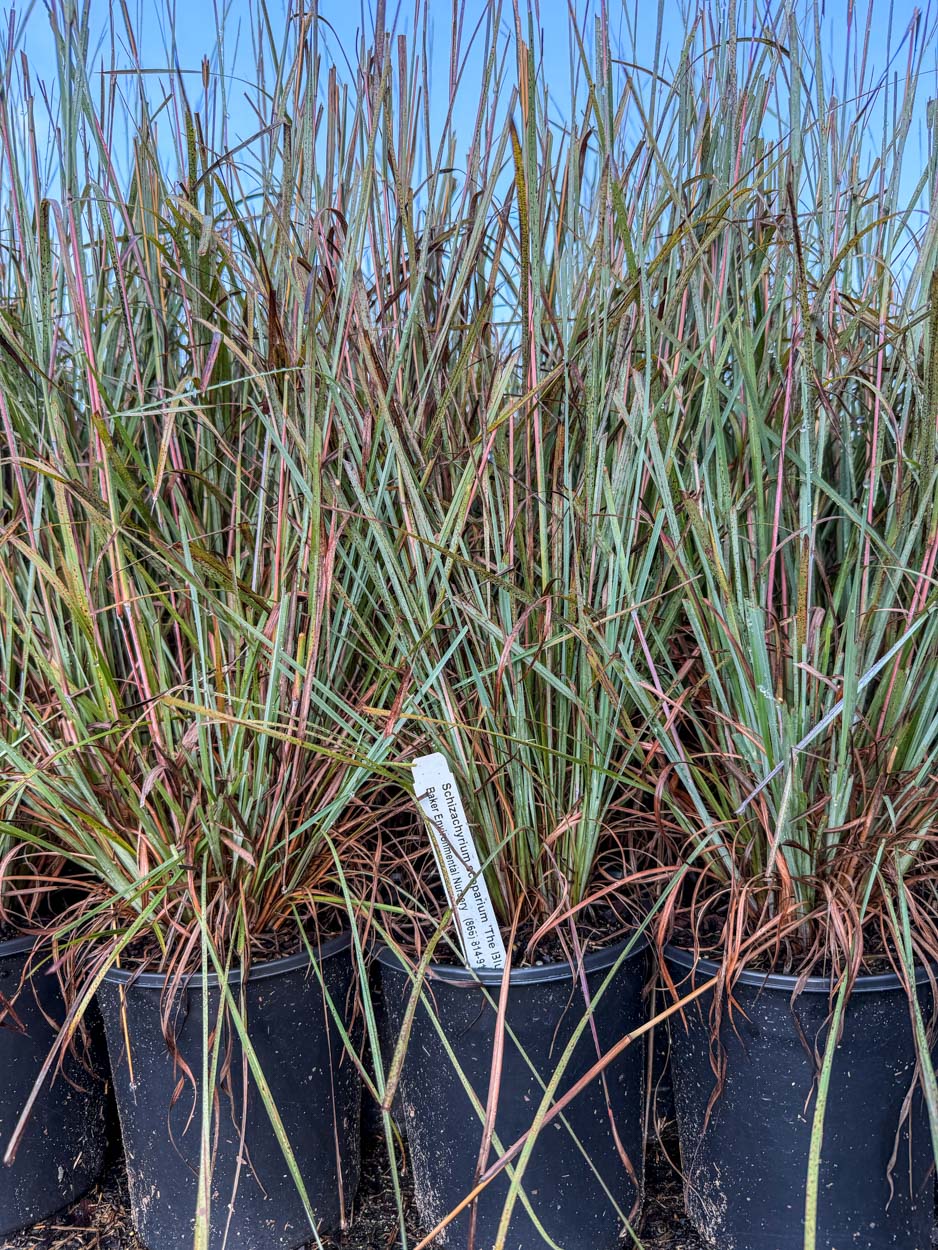
Confirm the cultivar is named on the plan so ‘The Blues’ is not swapped for generic little bluestem.
-
Verify the site receives full sun and drains freely, since dry, sunny conditions are where the species performs.
-
Note any salt exposure from roadways or coastal influence, which the species tolerates.
-
Calculate quantities with the plant calculator using the correct pattern, square or triangular.
-
Check whether habitat or native-plant goals are part of the approval, since the plant feeds birds with its seed.
-
Match grass massing with companion native perennials if the bed calls for mixed planting.
-
Contact the nursery early about contract growing if quantities are large or the schedule is phased.
-
Confirm your planting window with local extension guidance and your grower before scheduling delivery.
Little bluestem has earned its reputation on performance rather than novelty, and ‘The Blues’ gives that performance a stronger color signature. For contractors and municipalities installing native plantings at scale, it is a low-risk, low-maintenance line item that looks deliberate in year one and continues to hold the bed together as the rest of the planting matures.
Frequently Asked Questions
Is little bluestem drought tolerant?
Yes. Reference material on Schizachyrium scoparium describes a resilient grass that thrives in challenging conditions and withstands drought, and it is recommended as a decorative grass for dry, sunny areas. That tolerance is one reason it appears in commercial plantings with limited or no irrigation, including medians, slopes, and parking lot islands where consistent watering is not practical.
Does little bluestem tolerate salt?
The species is described as tolerating salty areas, which makes it a reasonable candidate for placements near roadways and in coastal-influenced projects where salt exposure is part of the site conditions. As with any specification, confirm the specific exposure levels on your site with the project’s landscape architect and your local extension resources before finalizing the planting plan.
Is little bluestem a warm-season or cool-season grass?
It is a warm-season grass. Schizachyrium scoparium is described as a North American native, warm-season prairie grass, and as a perennial ornamental grass in the Poaceae family. Warm-season grasses do their heaviest growing during warm weather, so plan establishment and inspection schedules around that growth pattern rather than expecting early cool-season flush.
Does little bluestem provide food for wildlife?
Yes. Reference descriptions note that little bluestem provides seeds for birds, which is a common reason the species is included in native planting plans and habitat-oriented projects. That seed value sits alongside its ornamental role, so the same mass planting can satisfy a design intent and contribute to the site’s habitat function without additional plant material.
Can Baker Environmental Nursery grow ‘The Blues’ to a project specification?
Yes. Baker Environmental Nursery is a wholesale-only grower offering contract growing that produces plants to specification for large-scale projects. Bring your plan sheets, cultivar names, quantities, and target install window to the team by phone or email, and we can scope a grow that matches the specification instead of substituting whatever is on hand.